Galvanised wire is the quiet workhorse of rustic decorating. It costs very little, it shrugs off a bit of damp, and it has that soft, dull grey finish that sits happily beside reclaimed wood, linen and earthenware. You don't need a workshop or a bench full of equipment — a kitchen table, a pair of pliers and half an hour is enough to turn a coil of wire into something you'll actually keep. Here's how to start, what to avoid, and ten projects that a beginner can finish in one sitting.
Pick the right wire before anything else
Galvanised wire is steel with a zinc coating, which is what gives it that matte, weathered look and stops it rusting indoors. It's sold as garden wire, floral wire and fencing wire, usually by diameter in millimetres, and the thickness dictates what you can make with it far more than any skill you bring to the table.
- 0.7–0.9mm bends between your fingers and holds a shape lightly. Ideal for photo holders, garlands, napkin rings and small ornaments.
- 1.2–1.6mm needs pliers but rewards you with real structure. This is the sweet spot for hooks, hearts, stars and curtain tiebacks.
- 2–3mm is a two-handed job, sometimes with a vice or a hammer. Use it for wall hooks, plant supports and anything bearing weight.
One thing to know: galvanised wire is springier than copper or aluminium, so it fights back a little. Bend it slightly past where you want it to end up, then ease it back. Buy bare wire rather than plastic-coated — the coating hides the very finish you're after. Rusty wire pulled from an old fence can look lovely, but it's often brittle, so keep it for decorative wraps rather than load-bearing parts.
A small toolkit, and what you can happily skip
You can make all ten projects below with five tools. Anything beyond that is a convenience, not a requirement.
- Side cutters for cutting. Flush-cutting ones give neater ends.
- Round-nose pliers for loops, curls and spirals.
- Flat-nose pliers for gripping, straightening and tightening bends.
- Needle-nose pliers for small spaces and tucking in wire ends.
- A fine file or emery board to soften sharp cut ends.
Add safety glasses, a pair of gloves, a steel rule and a jar for offcuts, and you're set. A small hammer and a scrap of hardwood make a decent anvil when you need to flatten a loop; a dowel, a tin can or a bottle makes a useful mandrel for consistent curves. Skip the full jeweller's kit for now. Most of it is designed for silver and soft metals, and you'll spend more time learning it than making things.
Safety habits worth forming early
Wire craft is low-risk, but cut ends are genuinely sharp and small offcuts travel. Snip with the wire held below shoulder height and away from your face, and wear eye protection — a short length of springy galvanised wire can flick a cut end further than you'd expect. Gloves stop the zinc coating marking your hands, and a quick wash afterwards is sensible before you eat.
The one rule to take seriously: don't heat galvanised wire. Soldering, torching or welding it releases zinc fumes, which are harmful to breathe. Join your wire with tight wraps, twists or a small vice instead — it suits the rustic look better anyway. Keep offcuts in a tin rather than on the floor, and give the carpet a quick sweep when you finish.
Ten beginner projects to work through
These are ordered roughly by difficulty. The first three take minutes; the last few ask for a bit more patience.
- Spiral photo holder. Take 40cm of 1.2mm wire, coil the middle around a pencil to make a flat spiral, and bend the two ends into a small stand. Slip a photo or a seed packet between the coils.
- Jam-jar lantern hanger. Wrap 1.6mm wire around the neck of a jar, twist the ends into a loop, and add a second loop on the opposite side. Run a short handle between them and hook it onto a branch or a beam.
- S-hooks. Bend a 20cm length into a long S around a dowel. Flatten the curves lightly with a hammer for a forged look. Useful in the kitchen, porch or shed.
- Napkin rings. Form 25cm of 1.2mm wire into a loose circle, then twist a small spiral or a heart onto the front. Make six and you have a matching set.
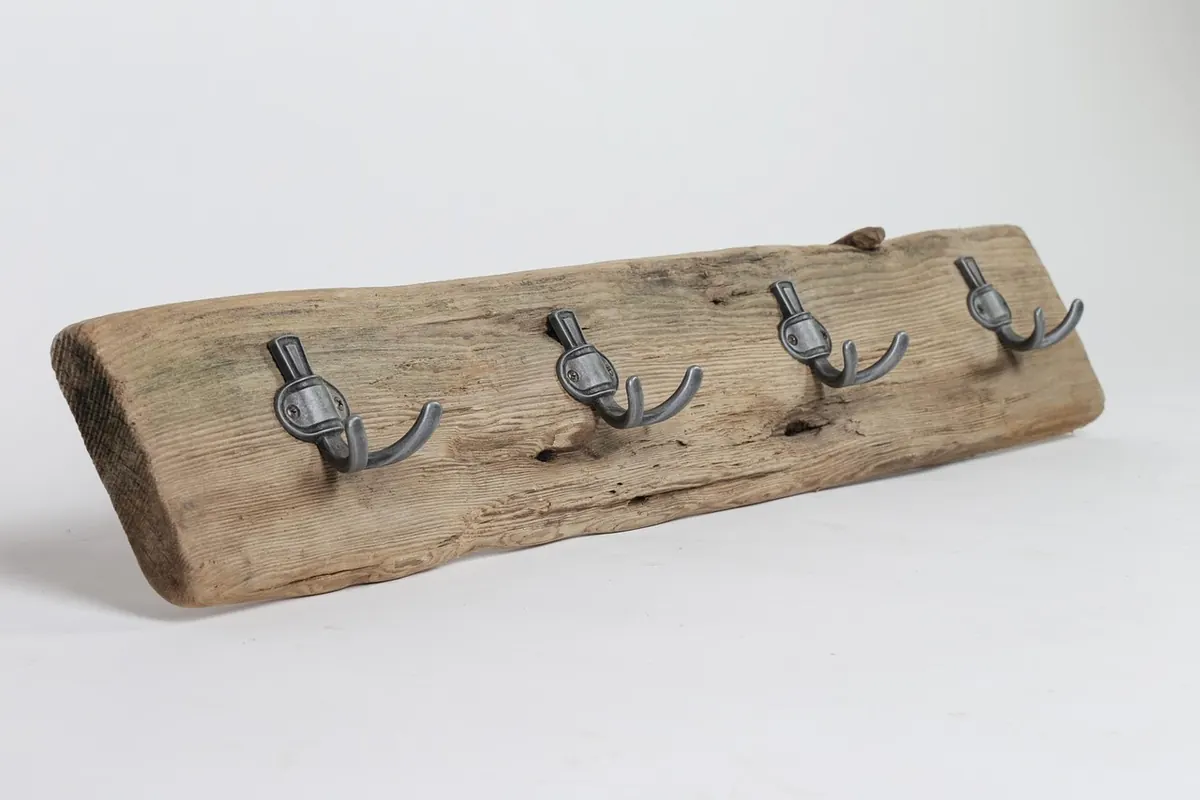
- Wall hooks for coats and keys. Use 3mm wire. Bend a J-shape around a vice jaw or a door handle, then tap the short arm flat and drill two screw holes. Sand the ends smooth.
- Heart and star ornaments. Draw the shape on paper first and bend the wire to follow it, twisting the two ends together at the top to form a hanging loop. Decorate with a scrap of ribbon.
- Tealight cage. Build a simple basket from four uprights of 1.6mm wire and two wrapped bands, leaving the top open. Line the base with a small piece of slate or a jar lid.
- Plant support hoop. Push two lengths of 2mm wire into a pot either side of a climbing plant and twist them together into a hoop. Rustic, invisible in a month, and sturdy enough for a small ivy.
- Curtain tiebacks. Bend 1.6mm wire into a wide arc with a curl at each end. Hang it over a cup hook rather than screwing through the wire, so it can be lifted off.
- Wire garland. Thread small beads, wooden shapes or dried citrus slices onto 0.9mm wire, spacing them with loose twists. Make it in sections and join them, so a long garland stays manageable.
Finishing touches that make the difference
Two minutes of finishing is what separates a homemade piece from a tidy one. Straighten any wobbles with flat-nose pliers, file every cut end until it's rounded, and give the whole piece a rub with wire wool to even out the grey. If you want a painted finish, galvanised steel needs an etch primer first or the paint will flake; if you want it darker, several months of indoor air will do more than any shortcut.
Keep galvanised pieces out of damp sheds and bathrooms where possible. Zinc develops a pale, chalky bloom in constant moisture, which is harmless but not especially pretty. A little ribbon, twine, driftwood or linen thread tied at a joint does a lot to soften the metal.
Start with one, then make the set
Begin with the spiral photo holder. It uses one short length of wire, takes five minutes, and teaches you how the metal behaves — how far it springs back, how tight a coil you can get before it kinks. Once that works, make four more and keep them as a matching set for a shelf or a windowsill.
Repetition is what builds control. When you find yourself bending the same loop over and over, make a simple jig: two nails in a block of wood, or a dowel clamped in a vice. That's the moment wire craft stops feeling fiddly and starts being genuinely quick — and you'll be looking at that coil of grey wire as a box of presents rather than a project.
Photo: wal_172619 / Pixabay